


Successful digital transformation starts long before software development. It begins with understanding people — not just “users,” but the human drivers behind behavior, decisions, and resistance to change.
Beyond Requirements: Design Thinking, Customer Discovery, and Story Thinking for Real Impact
Many organizations start digital initiatives with technology choices. At Vision, we start earlier — with discovery, shared understanding, and alignment around real user needs.
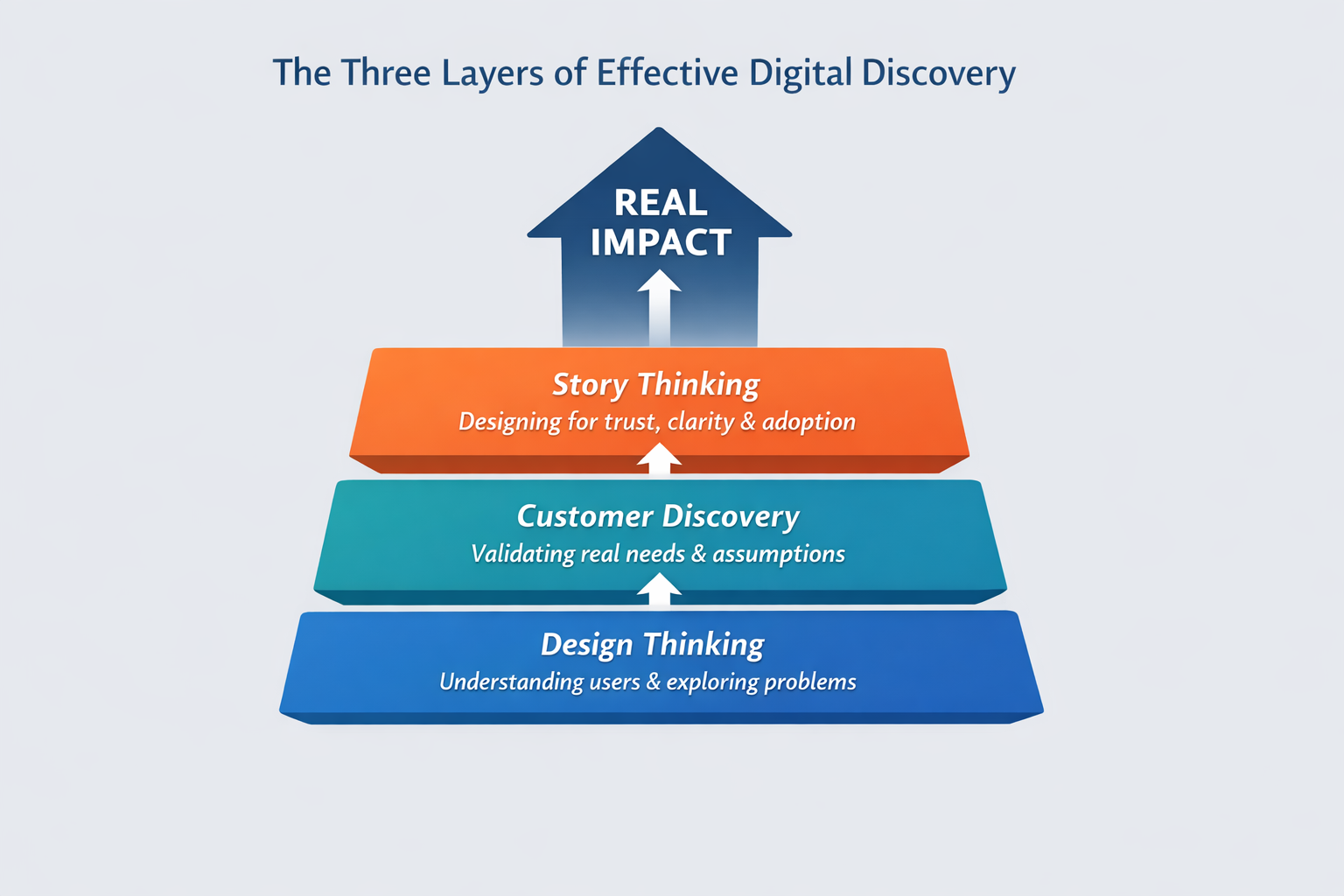
In complex academic and institutional environments, traditional requirements gathering is not enough. That’s why Vision combines:
- Design Thinking for user-centered problem solving,
- Structured Customer Discovery to validate real needs early,
- Story thinking to understand the deeper motivations shaping how people interact with systems.
Research on human cognition — including concepts such as Primal Intelligence — reminds us that technology adoption is rarely purely rational. It is often emotional and instinctive, rooted in fundamental needs such as safety, belonging, autonomy, and trust.
Project Context: Consultancy and Learning Through Real Delivery
Vision is currently delivering consultancy services for The Non-University Tertiary College, part of the National University of Science and Technology POLITEHNICA Bucharest.
The goal is to develop a digital platform supporting educational and operational workflows — while also enabling students to learn how digital solutions are built in real institutional contexts.
This initiative is designed as a hands-on learning journey where participants gain experience in:
- identifying real user needs,
- framing problems correctly,
- designing usable solutions,
- developing iteratively with Agile methods.
Discovery First: Understanding Needs Beyond Assumptions
In institutional environments, requirements are rarely clear at the start. Multiple stakeholders, evolving processes, and hidden constraints make early assumptions risky.
That is why Vision approaches requirements capture as a structured discovery process, blending Design Thinking workshops with Customer Discovery techniques. So far, more than eight interactive sessions with around 20 participants have mapped key workflows and identified critical pain points — including fragmented communication between academic and administrative processes.
This discovery-driven approach reduces implementation risk and ensures technology investments address real operational challenges.
Designing for Adoption: Story Thinking and the Human Layer
Beyond workflows and process diagrams, transformation is won or lost at the human level — how users perceive control, clarity, trust, and the effort required to use a platform every day.
Inspired by Primal Intelligence, we design with deeper user instincts in mind:
- the need for control and clarity,
- fear of complexity or change,
- trust in systems and data,
- the emotional experience of daily interaction (friction vs. ease).
This ensures solutions are not only functional, but genuinely adoptable.
From Insight to Design: Building Around Real Users
Vision guides the platform’s design and development through iterative, user-centered methods:
- defining user scenarios and use cases,
- creating and validating prototypes early,
- establishing UI/UX principles for accessibility and consistency.
Stakeholders interact with the solution from the beginning, reducing uncertainty and improving engagement.
Learn more about Vision’s approach: Requirements Analysis & UX
Agile Delivery Through Evolutive Prototyping
Rather than waiting for a “final” delivery, Vision leads an Agile model based on evolutive prototyping:
- successive functional releases,
- continuous user feedback,
- iterative refinement of requirements and implementation.
This ensures adaptability — essential in educational and institutional digital initiatives.
Knowledge Transfer: Training for End-to-End Delivery
A defining element of this initiative is capability building. Vision provides consultancy that helps students develop practical skills in:
- structured analysis,
- design thinking methods,
- customer discovery,
- real-world Agile software delivery.
This dual focus — solution delivery and knowledge transfer — ensures long-term value beyond the scope of a single project.
Conclusion
This project shows how Design Thinking becomes a real delivery capability when combined with structured Customer Discovery and a deeper understanding of human behavior through Primal Intelligence.
By guiding students and stakeholders through analysis, design, development, and adoption, Vision bridges strategy, technology, and human experience — turning complex objectives into usable, sustainable digital platforms.