


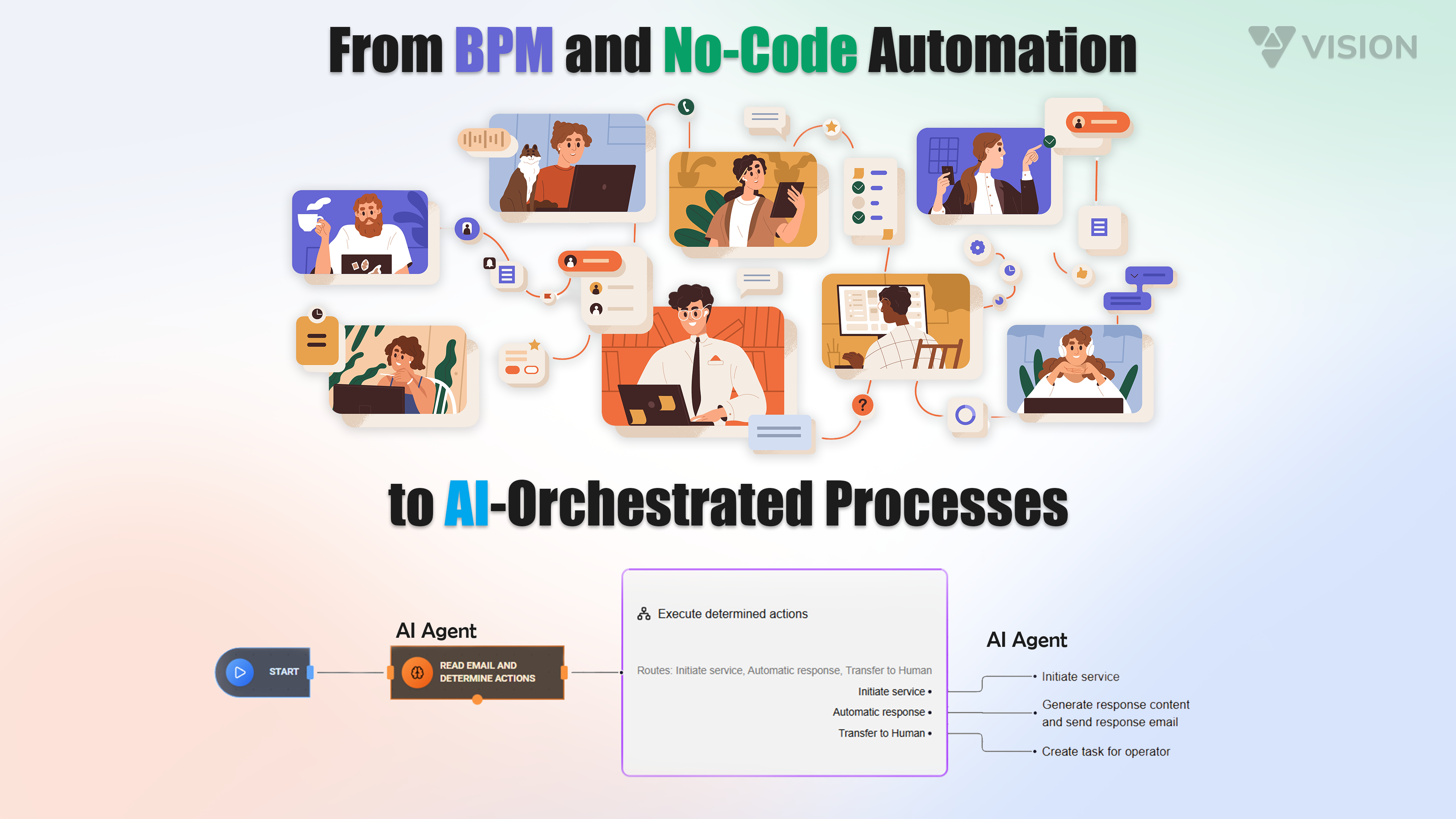
As organizations move from BPM and no-code automation toward more advanced digital operations, the next step is clear: AI-orchestrated processes. Automation accelerates execution, but intelligence is what makes processes context-aware, adaptable, and capable of handling real-world complexity.
The Next Step in Intelligent Process Digitalization
As organizations mature digitally, automation alone is no longer sufficient. Processes must understand context, handle unstructured information, and adapt dynamically. This is where AI orchestration becomes a natural extension of BPM and no-code platforms.
- Context Awareness → processes interpret intent and business context, not just rules.
- Unstructured Inputs → emails, documents, and free text become actionable workflow triggers.
- Adaptive Execution → decisions and routing can adjust dynamically as conditions change.
The Evolution of BPM: From Structured Flows to Intelligent Execution
Traditional BPM focuses on predictable, rule-based workflows. No-code platforms expanded these capabilities to business users, reducing dependency on development teams. However, modern processes increasingly involve information and decisions that cannot be fully predefined.
- Unstructured content – emails, documents, and free-text inputs.
- Complex journeys – end-to-end customer or employee experiences across channels.
- Non-deterministic decisions – decisions that require interpretation, prioritization, or guidance.
By embedding AI directly into workflows, BPM evolves from simply executing steps to orchestrating intelligence within them.
How Vision App Maker Enables AI Orchestration
Vision App Maker extends BPM and no-code automation with AI Flow, a visual AI orchestration engine integrated directly into process modeling. AI Flow is built around a multi-agent architecture, where specialized AI models collaborate to solve complex tasks with governance and transparency.
AI Flow Core Capabilities
- Multi-Agent Architecture – multiple specialized AI agents collaborate on complex tasks.
- Autonomous Execution – an AI agent can execute a workflow step independently when permitted.
- Human Validation – agents can propose outcomes for approval based on roles, permissions, and governance.
- Built into Process Design – AI orchestration is modeled directly alongside BPM workflows.
AI Flow in Action: Visual, Configurable Intelligence
From the same visual designer used for BPM workflows, users can define reusable AI-powered action blocks that can be applied across multiple processes.
- Automatic email intake – interpret incoming requests and initiate the right process automatically.
- Document OCR & extraction – capture structured data from documents and attachments.
- Intelligent routing – assign tasks based on context, content, workload, or priority.
- Decision support – generate recommendations when full automation is not required.
AI actions can be used across the platform:
- Inside user interfaces – assist users with contextual guidance and smart actions.
- Within business rules – enrich rule logic with AI-driven interpretation and recommendations.
- At any workflow step – embed intelligence wherever decisions or understanding are needed.
Scalable Across Industries and Channels
AI capabilities are available in internal systems and can be securely exposed to external portals, mobile applications, or self-service interfaces. By modeling AI as part of the process, organizations can support complex end-to-end journeys without increasing operational complexity.
- Customer service & operations – faster intake, triage, and resolution.
- Finance & compliance – document validation, policy checks, and audit support.
- HR & internal services – employee requests, onboarding, and knowledge assistance.
- Manufacturing, utilities, & logistics – intelligent coordination across operational workflows.
Governance, Deployment, and Predictability
All AI capabilities are delivered as platform modules, deployed as containers and licensed perpetually. There are no usage-based or recurring AI costs, ensuring predictable long-term operation. Technical specifications and hardware requirements are provided to support different performance and response-time needs.
- Container-based deployment – modular, scalable, and enterprise-ready implementation.
- Perpetual licensing – long-term predictability and control over costs.
- No usage-based AI charges – stable operating model without variable AI consumption fees.
- Performance-ready architecture – hardware guidance aligned with response-time expectations.
Conclusion
The combination of BPM, no-code, and AI orchestration represents the next phase of digital process evolution. With AI Flow in Vision App Maker, organizations can design processes that are not only automated, but context-aware, adaptive, and scalable — turning BPM into the foundation for truly intelligent operations.
Learn more about Vision App Maker and AI Flow and explore how AI orchestration can accelerate intelligent process digitalization across your organization.