


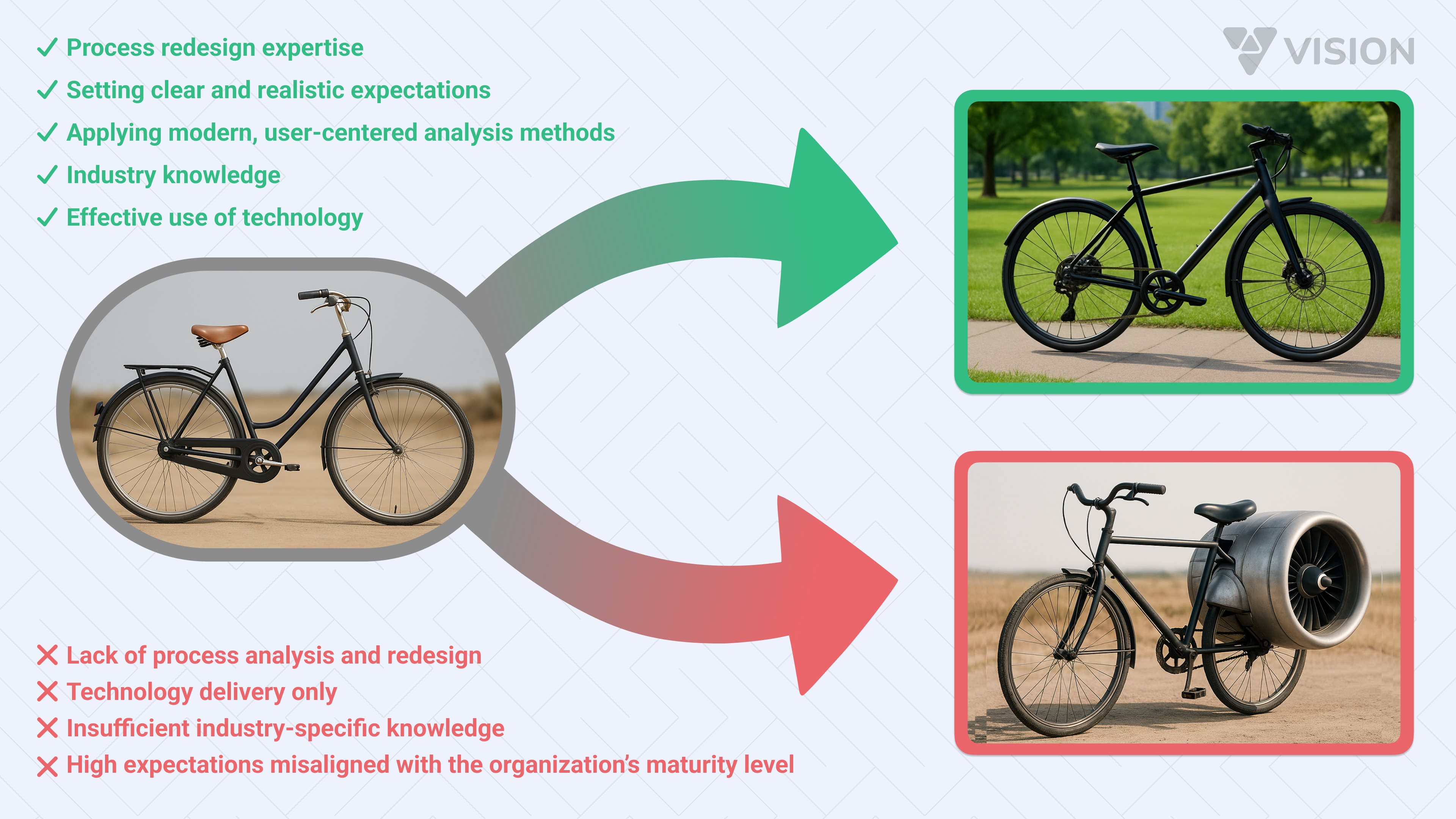
Digitalization and automation have become strategic imperatives for most organizations. The pressure for efficiency, transparency, cost reduction, and faster operations pushes leaders to invest rapidly in new technologies aimed at automating workflows.
Yet few acknowledge a critical truth: digitalization and automation do not fix broken processes — they amplify them.
When digital transformation is led by a team without expertise in understanding, analyzing, and designing business processes, the result is often a costly, stressful initiative that disrupts operations instead of improving them.
Another key success factor is organizational maturity. You cannot jump overnight from low maturity — with informal or undefined processes — to optimized, automated, scalable workflows. Real transformation requires time, clarity, structure, and a willingness to rethink how work is done. Technology alone is never enough; organizational transformation is equally essential.
The Real Problem: Digitalizing Without Redesigning Means Digitalizing Chaos
Many companies start from the false assumption that technology will "bring order" into the daily work. But in organizations with low maturity, unclear responsibilities, or processes dependent on individuals, digitalization and automation simply become multipliers of existing chaos.
When a team without process expertise attempts to implement digitalization, negative effects appear immediately:
- Workflows that don’t reflect operational reality: Systems attempt to replicate informal, undefined, or contradictory processes. The result: bottlenecks, delays, frustration.
- Incorrectly designed rules and approvals: Without a clear understanding of internal responsibilities, approval flows become inconsistent and unclear.
- More work instead of less: Employees end up working simultaneously in the new system, in Excel, and on WhatsApp — increasing chaos and decreasing trust in technology.
- Solutions that don’t fit the industry: Generic digitalization without understanding the specific domain (banking, utilities, construction, retail, public administration, etc.) leads to theoretical, non-operational solutions.
- Low adoption: People don’t use what they don’t understand, and poorly designed processes exponentially increase resistance to change.
The Core Issue: Lack of Process Modeling Expertise and Industry Knowledge
Digitalization and automation do not start with the platform.
They do not start with software development.
They do not even start with configuration.
They start with fundamental questions:
- What is the current workflow and where does it break?
- Who is responsible for each step?
- What can be standardized?
- What can be eliminated?
- What is worth automating?
- What does the optimized version of the process look like?
This specific type of structured analysis — common in process re-engineering and business process management — is not a technical formality. It is the backbone of any successful implementation. Companies lacking this expertise often deliver solutions that look elegant on the surface but fail in real-life operations.
How Vision Makes the Difference: Technology Is Only 50% of the Project. The Rest Is Process, Culture, and Methodology.
Vision does not simply implement technology. Vision implements organizational and operational transformation.
Deep Expertise in BPM and Process Re-engineering
Every project begins with a thorough AS-IS process mapping and the design of the optimized TO-BE model. We do not digitalize the current processes — we improve them, standardize them, and make them scalable. Our implementation experts also manage expectations appropriately: operational excellence is not achieved instantly by installing a tool — it requires organizational change.
Design Thinking Applied to Real Business Challenges
Vision uses modern, human-centered methods to: understand real user needs, simplify workflows, design intuitive experiences, eliminate unnecessary complexity. The result? Solutions that people adopt quickly and actually enjoy using.
Industry Know-How
Vision experts have hands-on experience across industries such as: banking and insurance, public services, utilities and distribution, manufacturing, professional services, logistics and transportation, and more. This ensures that our solutions are not only technically correct but also operationally effective.
Visible Impact from the First Month
Vision’s projects deliver measurable, early results: 40–70% reduction in processing times, elimination of errors and duplication, significant automation levels, full traceability, real standardization, reduced dependency on key individuals.
Simplicity Where Others Create Complexity
Vision App Maker — our low-code platform for workflow automation and digitalization — enables rapid optimization and continuous adaptation without expensive custom development.
Conclusion
Poorly executed digitalization is costly, while well-executed digitalization unlocks sustainable growth — but it requires time, commitment, and a foundation of trust.
When digitalization and automation are done without process expertise, a dangerous effect appears: technology accelerates chaos instead of performance.
But with the right know-how, digital transformation becomes a genuine growth engine:
- clear, standardized processes
- scalable operations
- clean data for decision-making
- real efficiency
- teams freed from repetitive tasks
- full visibility and control
Another essential ingredient is mutual trust between the implementation team and the client’s internal teams. Both sides must understand they are in the same boat — lack of trust harms both and jeopardizes the project.
Vision: The Difference Between Digitalization and Digital Transformation
Vision is a strategic partner, not merely a software provider. Combining user-centered methods like Design Thinking with deep industry expertise and strong process engineering capabilities, Vision delivers projects that don’t just digitalize workflows — they fundamentally transform them.
If your organization wants digitalization and automation that truly work, Vision is the difference between “another complicated project” and measurable operational success.